


Total ankle replacement
Foot & ankle surgery
Ankle · foot
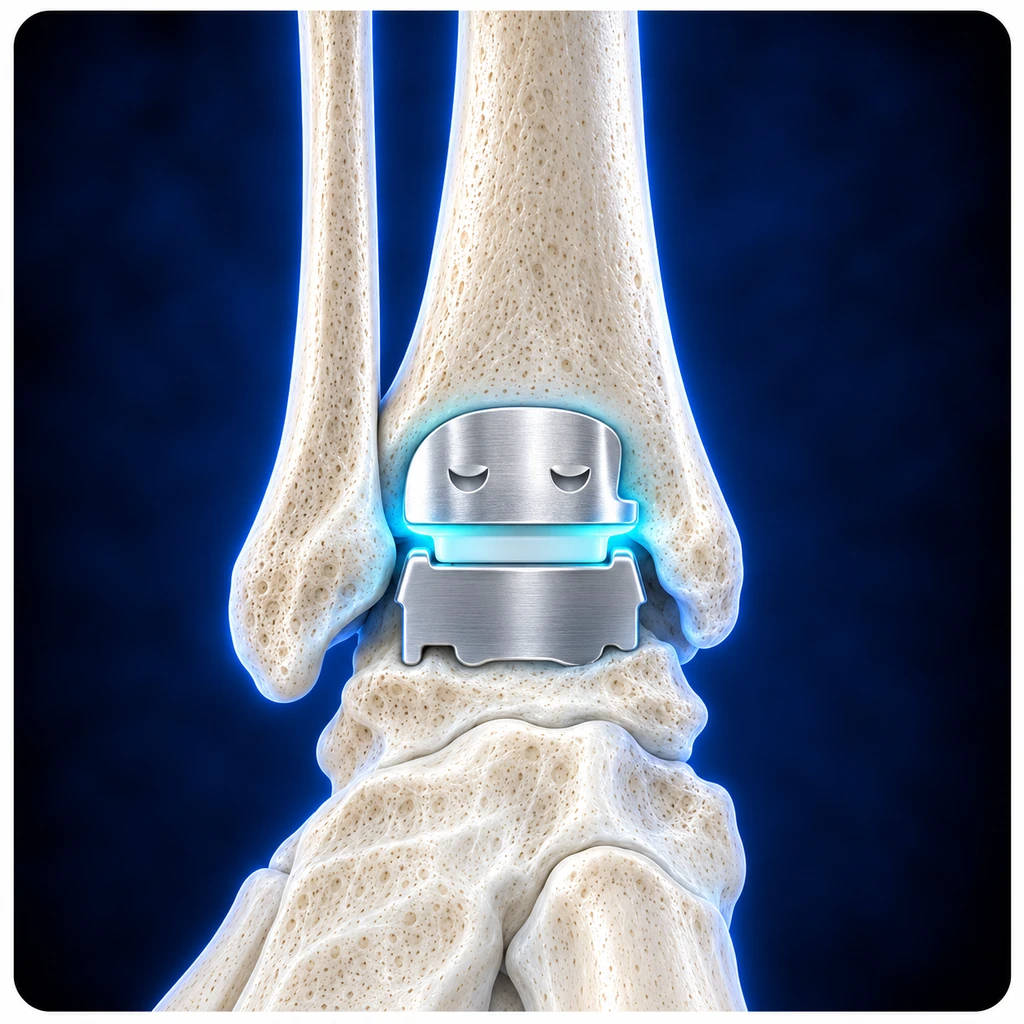
When ankle arthritis has reached its final stage and almost no cartilage remains, the bones meet directly and every step hurts. The worn joint surfaces are removed and replaced with an artificial joint; unlike fusion, which stiffens the joint, this leaves the ankle its range of movement.
Anesthesia, hospital stay and recovery time depend on the extent of injury and your general condition. The operating surgeon explains this after the consultation.
When surgery is indicated
- End-stage ankle arthritis with almost no cartilage left
- Pain not controlled by non-surgical treatment such as medication, injections or bracing
- Arthritis that has developed after a fracture or repeated ankle ligament injuries
- Pain that shortens how far you can walk and limits daily life
Total ankle replacement — benefits
- Pain under weight-bearing is reduced, so you can walk further.
- Because the ankle keeps its range of movement, walking is more natural than after fusion.
- The ankle is not stiffened, so less strain is passed on to the neighbouring joints.
Process
How surgery proceeds
This is the shared pathway for the Surgery Center. Details for each procedure are covered in the consultation.
- 01
Precise diagnosis
MRI and CT are taken the same day and read by a radiologist that same day.
- 02
Surgical consultation
The operating surgeon explains in person why surgery is needed, what the alternatives are and how recovery is expected to go.
- 03
Surgery · inpatient care
The operation is performed in the annex theatre, and recovery is managed on the ward as the condition requires.
- 04
Rehabilitation · follow-up
After discharge the same team continues to follow your progress and rehabilitation in the outpatient clinic.